Berber symbols: what the patterns on Berber rugs mean
· 5 min read
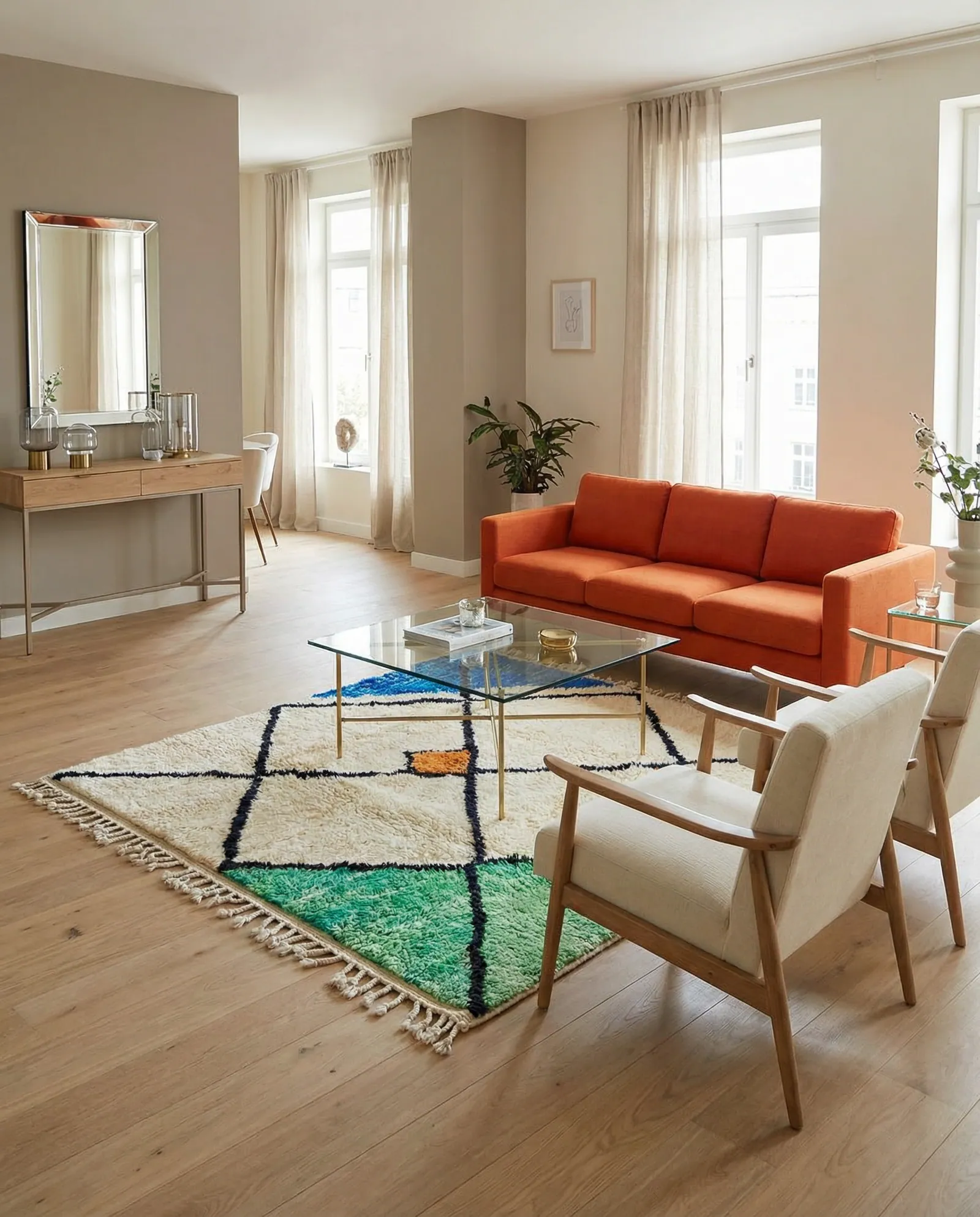
In short: the symbols on Berber rugs are geometric patterns – diamonds, eyes, zigzags, crosses, triangles, the Yaz – woven for generations by Amazigh women in Morocco. The most common interpretations link them to femininity and fertility, to protection, to water and to nature. Their meaning is never fixed, though: it depends on the region, the tribe and the weaver herself.
Where do Berber symbols come from?
The Amazigh (Berber) peoples of North Africa use the same vocabulary of shapes on many surfaces: rugs, pottery, jewellery and, in the past, women’s tattoos. This repertoire has been passed down mostly by word of mouth, from mother to daughter, while working at the loom.
A Berber rug is therefore more than decoration. For the weaver it is also a way of telling a story: a wedding, a birth, a wish for the family’s protection, or simply the landscape around her. That is why no two rugs are ever quite the same.
The main symbols and their meaning
These are the patterns you will see most often on Berber rugs, with their most common interpretations. Think of them as a reading guide rather than a dictionary.
- The diamond – the Berber motif par excellence. It is most often associated with women, fertility and protection. Diamond grids are the signature of Beni Ourain-style rugs.
- The eye (a diamond with a central dot) – a protective symbol meant to keep the evil eye away from the home.
- Zigzags and chevrons – often read as flowing water, the path of life or a protective snake. In mountain country they can also stand for the ridges of the Atlas.
- The cross and the X – a motif of protection and encounter, sometimes read as a guiding star or the four directions.
- The triangle and the fibula – the triangle recalls the fibula, the traditional brooch that fastens women’s garments. It is usually linked to femininity and to married women.
- The tree of life and the ear of wheat – upright, branching shapes associated with growth, abundance and the continuity of the family.
- The Yaz (ⵣ) – the letter of the Tifinagh alphabet at the centre of the Amazigh flag. It stands for the “free person”, the meaning of the word “Amazigh”.
- Lines and bands – they structure the rug, divide areas or depict ground, a field or a path.
Why the same motif does not always mean the same thing
There is no official dictionary of Berber symbols. Meanings travel orally, change from one valley to the next and have sometimes been lost. Many of the “symbol dictionaries” published today are modern reconstructions. A weaver may also choose a motif simply because she likes it, or improvise as she weaves.
That is exactly what gives a handmade rug its value: the patterns are irregular, sometimes asymmetrical, and carry the mark of a hand. Be wary of a seller who “translates” every shape too precisely – the honest approach is to speak of interpretations.
Symbols by style: Beni Ourain, Azilal, Mrirt
Each major family of Berber rugs uses symbols in its own way:
- Beni Ourain: an ivory ground of natural wool with brown or black patterns, usually diamonds in a grid. Graphic and understated. See Beni Ourain rugs.
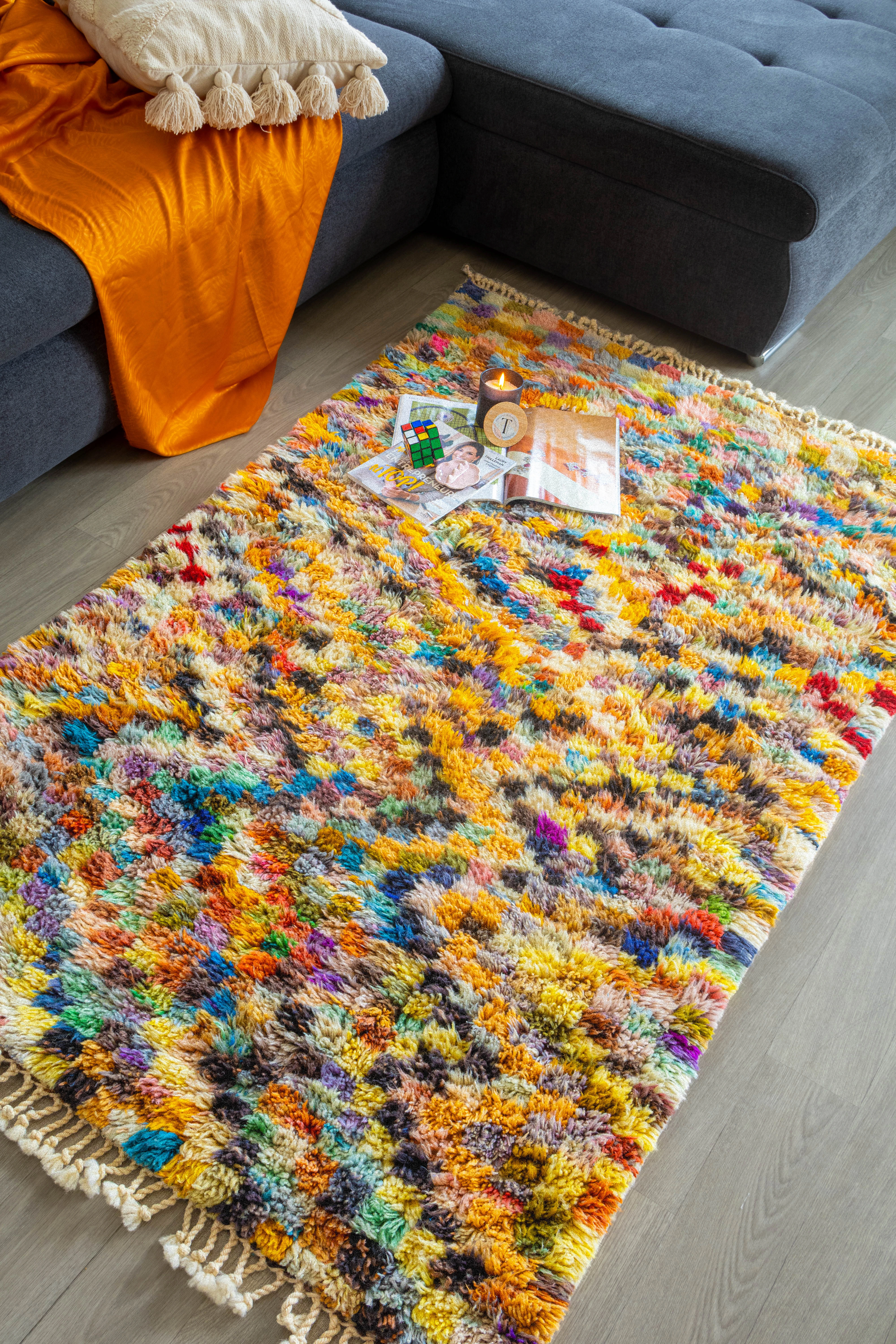
- Azilal: a light ground with very colourful, freely placed motifs. The symbols feel more spontaneous, almost like drawings. See Azilal rugs.
- Mrirt: thick, silky wool with patterns that are often subtle or tone-on-tone, sometimes geometric. This is the style TAKNAJ specialises in. See Mrirt rugs.
For a detailed comparison of the three styles (wool, pile height, use), read our guide Mrirt, Beni Ourain or Azilal: the differences. And to tell a genuine handmade rug from a copy, see how to recognise an authentic Berber rug.
Colours: what people read in them
In traditional rugs, colour depended first on the materials at hand: undyed natural wool in ivory, brown or black, and plant dyes such as madder for reds, henna for oranges or indigo for blues. Today many rugs also use modern dyes that hold up better to light.
The most common interpretations link red to strength and protection, white to purity and light, blue to water and sky, and yellow to the sun. As with the patterns, these are widespread readings rather than rules: a weaver also chooses her colours according to the wool she has and to her own taste.
Rugs for life’s great moments
Some pieces were woven for a specific occasion. Handiras, for example, are wedding blankets from the Middle Atlas, sometimes decorated with sequins, which the bride wore or received. In such pieces, symbols of protection and fertility take on their full meaning: the textile accompanies the new family.
This bond between weaving and family life explains why Berber patterns remain so personal – and why a handmade rug is often handed down from one generation to the next.
How to read the patterns on your rug
Start with the overall composition: a central motif surrounded by repeats, a regular grid or scattered shapes. Then look for the basic forms described above – a large diamond often contains smaller diamonds, eyes or crosses.
Notice the small irregularities too: a line that drifts, a motif that changes size, a colour that varies slightly. They are not flaws but the traces of hand-knotting, knot after knot.
Choosing a Berber rug by its patterns
The right pattern depends above all on your interior. Diamond grids bring rhythm to a minimal room, a rug with free, colourful motifs becomes the centrepiece of a calm living room, and an almost plain rug lets the material speak.
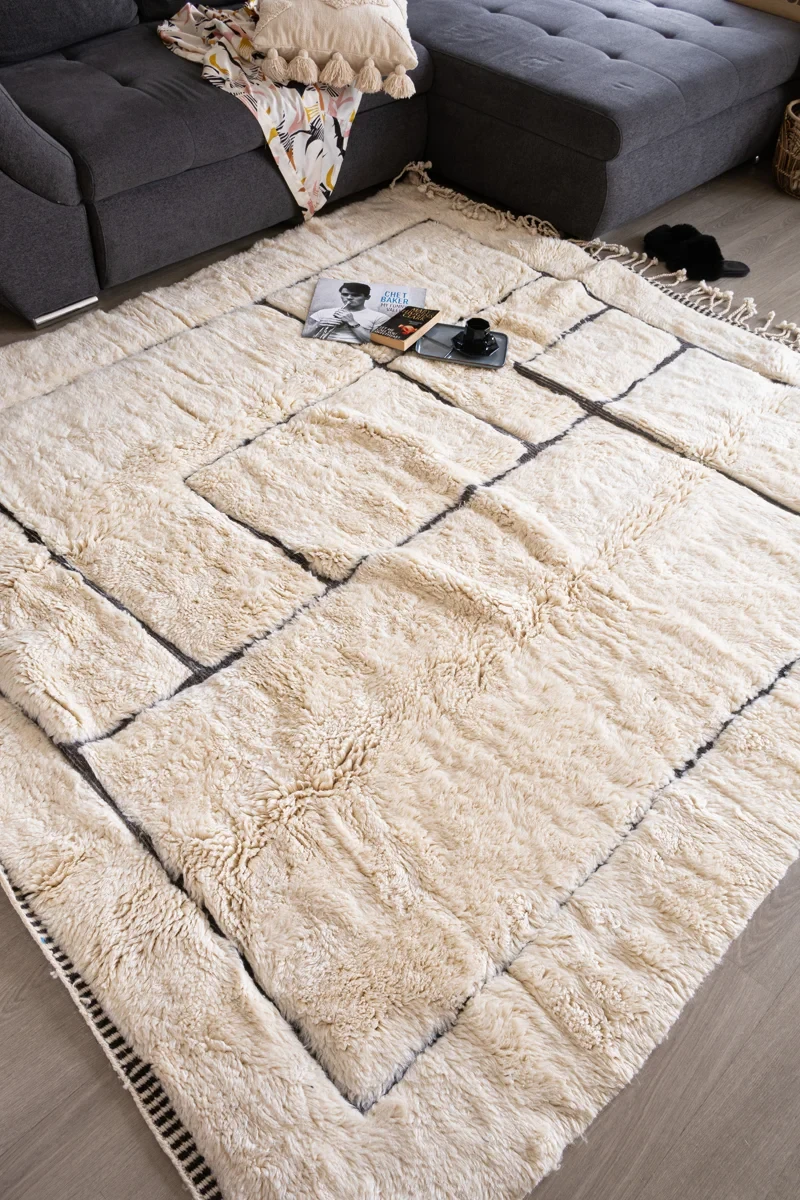
For bold geometric patterns, the Labyrinthe Mrirt rug plays with graphic lines on natural wool.
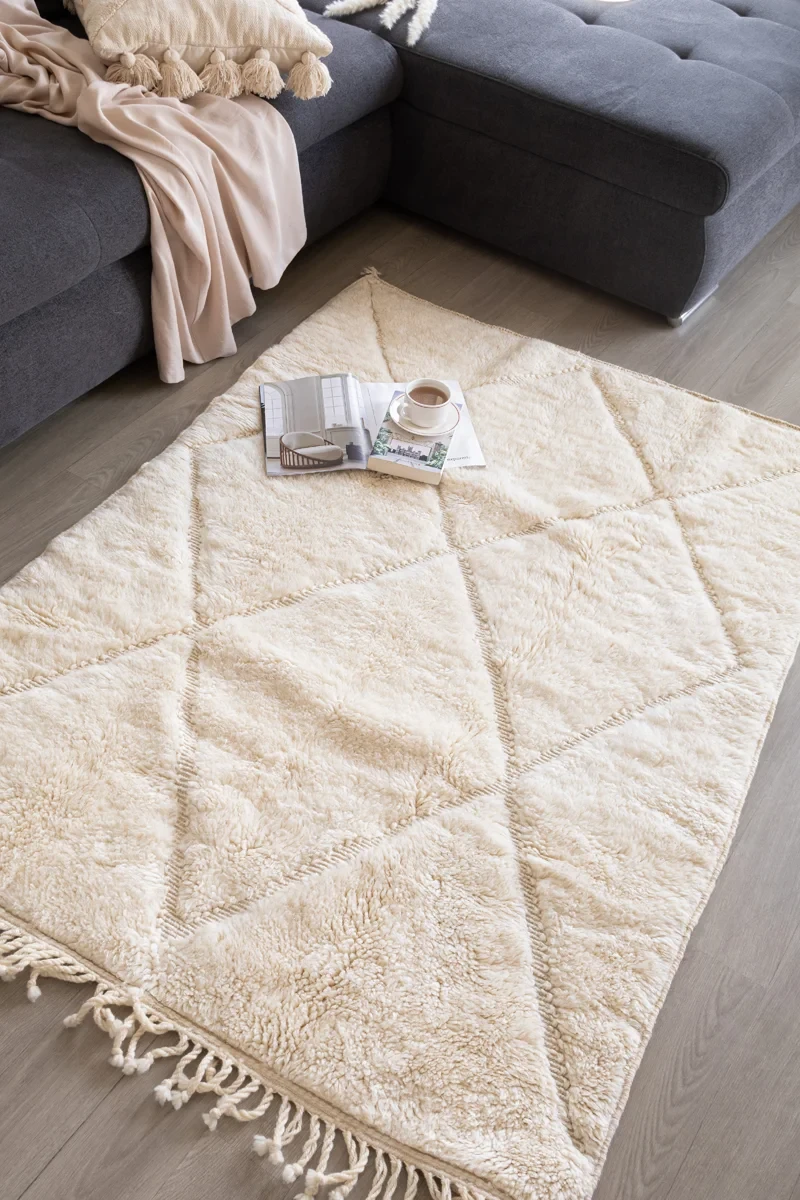
If you love the classic diamond in a softer form, the Nuage Mrirt rug draws a light grid on very thick white wool.
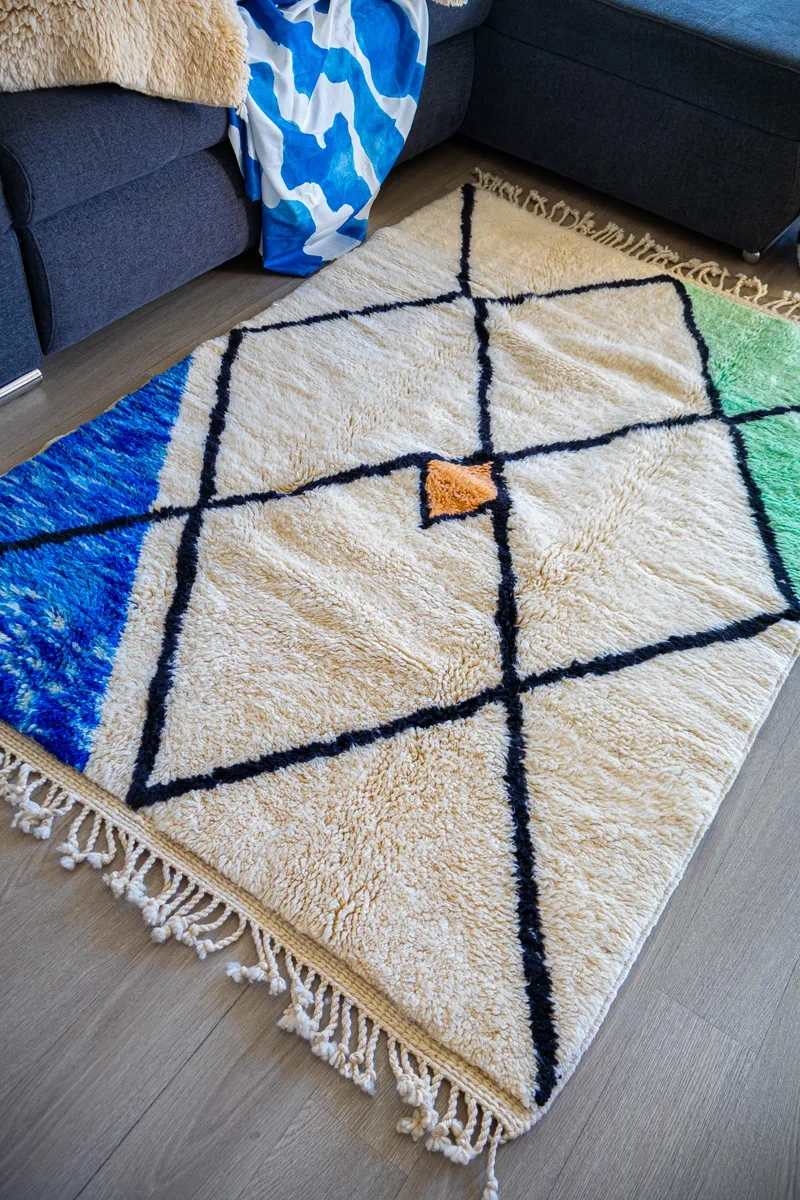
For bold, high-contrast diamonds, the Blue Green Mrirt rug combines large dark lines with touches of teal and green.
And for the free, colourful spirit of Azilal motifs, the Pixel Azilal rug brings many symbols together in a joyful composition.
- Berber symbols
- patterns
- Beni Ourain
- Azilal
- Amazigh culture
Frequently asked questions
What does the diamond mean on a Berber rug?
The diamond is the most widespread Berber symbol. It is most often associated with women, fertility and protection. With a dot in the centre it becomes an “eye”, meant to protect against the evil eye.
Do Berber symbols have a fixed meaning?
No. Their meaning is passed down orally and varies by region, tribe and weaver. That is why we speak of common interpretations rather than an official dictionary.
What does the ⵣ (Yaz) symbol stand for?
The Yaz is a letter of the Tifinagh alphabet and sits at the centre of the Amazigh flag. It symbolises the “free person”, which is what the word “Amazigh” means.
Which Berber rug style has the most patterns?
Azilal rugs have the most colourful, freely placed motifs. Beni Ourain rugs mostly show dark diamond grids on an ivory ground, while Mrirt rugs are often more understated.