How Berber Rugs Are Hand-Knotted: A Complete Guide
· 3 min read
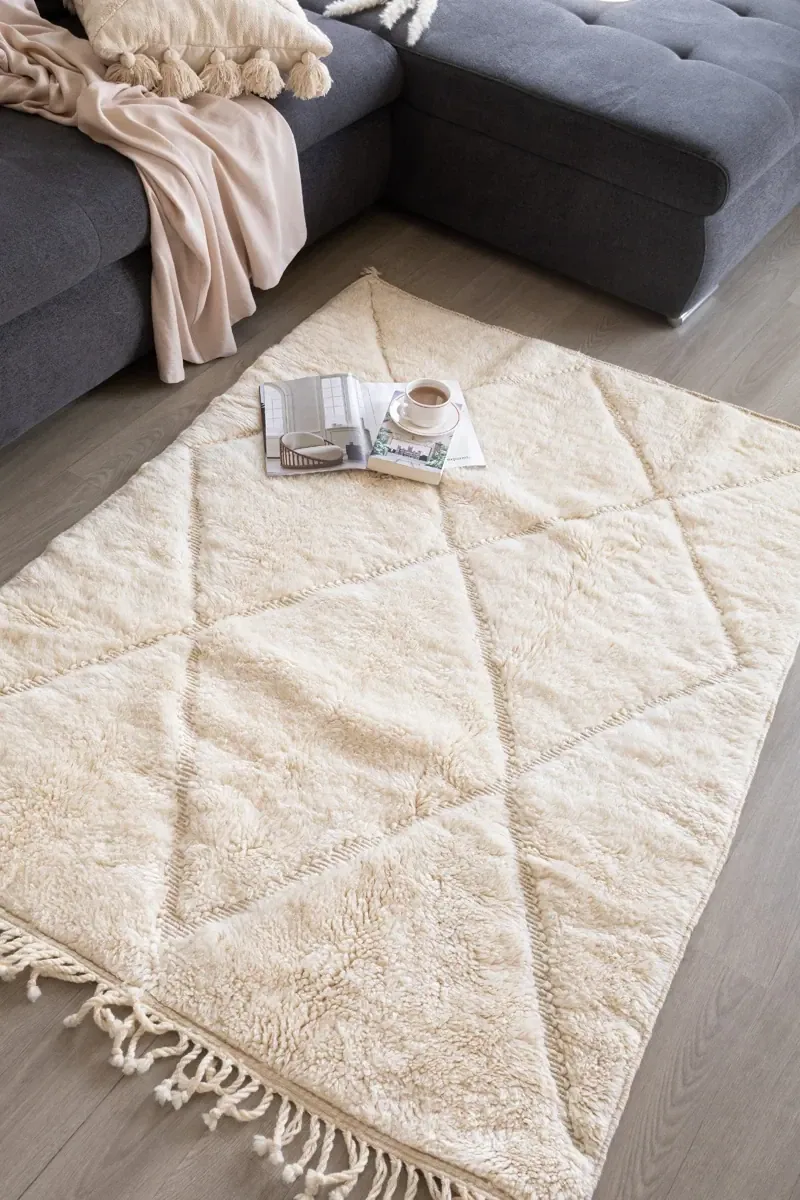
In short: A genuine Berber rug is made entirely by hand on a vertical loom. Women weavers in Morocco's Middle Atlas tie each knot individually around pairs of warp threads, row by row, building up both the pile and the pattern as they go. Because no cartoon or printed guide is used, every rug is a one-of-a-kind creation in 100% natural wool.
The vertical loom: where every rug begins
Before the first knot is tied, the weaver prepares her loom. Warp threads are stretched tightly between two horizontal beams, forming the skeleton of the future rug. Their spacing and tension will determine how dense and how heavy the finished piece will be.
In the Middle Atlas, these looms are often set up inside the home itself, passed down alongside the knowledge of how to use them. The wool — 100% natural — is dyed before knotting begins, each colour chosen deliberately by the weaver as part of her overall composition.
The Berber knot: technique step by step
The most common knotting technique in Middle Atlas rugs is the asymmetric knot, also known as the Persian or Senneh knot. The weaver wraps a length of wool around two adjacent warp threads, then pulls both ends forward to create the pile. This single motion, repeated thousands of times each day, demands both precision and endurance.
After each row of knots, one or more weft threads are woven horizontally across the full width of the loom to lock the knots in place. The weaver then beats everything down firmly with a metal or wooden comb. It is this cycle — knots, weft, beating — that gives a Berber rug its characteristic density and resilience underfoot.
Pattern-making from memory: no cartoon required
Perhaps the most surprising aspect of Berber weaving is that most weavers in the Middle Atlas work without any drawn pattern. Diamonds, chevrons, stepped lines and symbolic motifs emerge directly on the loom, guided by memory, intuition and a visual language inherited from earlier generations. This freedom is precisely what gives each rug its distinct personality.
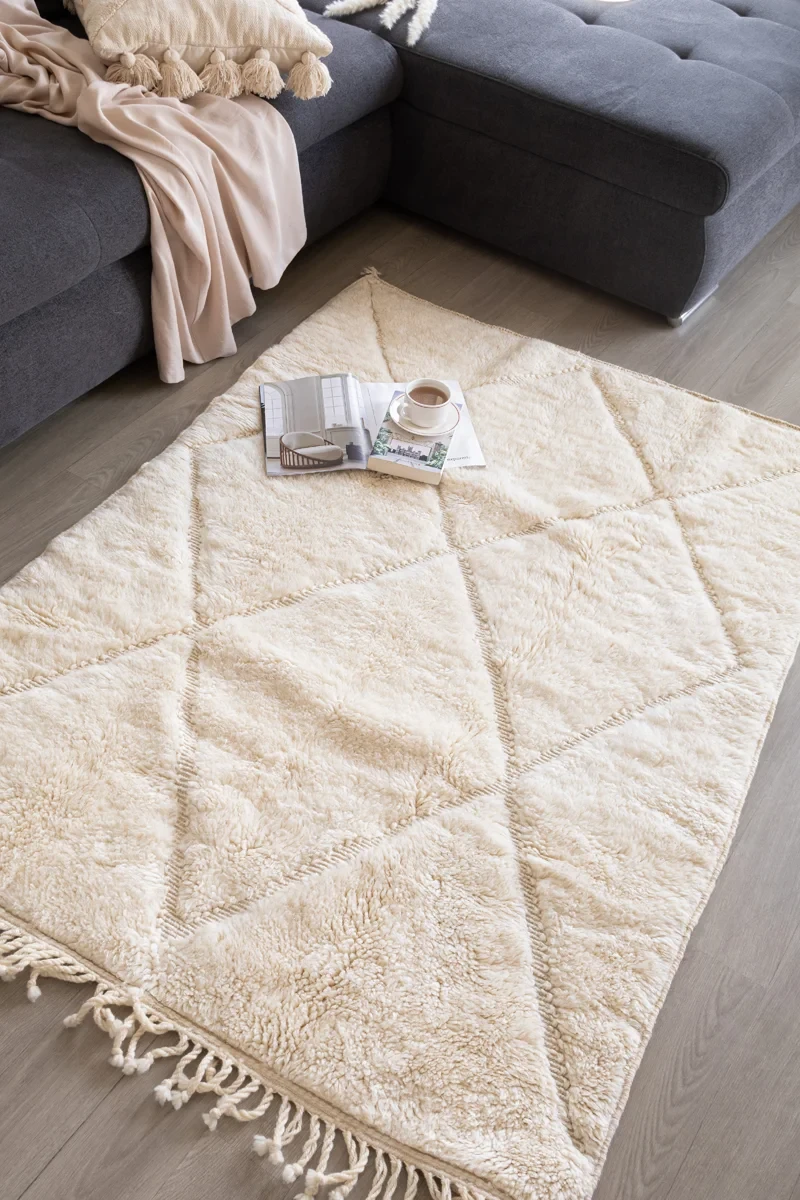
The Mrirt White Rug – Nuage is a perfect illustration of this restraint: its thick, cream-white wool lets the very texture of the knots become the design — quiet, tactile and deeply considered.
Rug styles: Mrirt, Azilal and Beni Ouarain explained
When you see these names, they refer to weaving traditions, not to specific workshops or villages. Each style has its own visual identity:
- Mrirt: Long, dense pile; palette ranging from soft neutrals to bold colour; tight, even knotting.
- Azilal: White or cream ground; vivid, spontaneous motifs; a more painterly, expressive feel.
- Beni Ouarain: Undyed natural wool; geometric black or brown patterns on an ivory field; very dense pile.
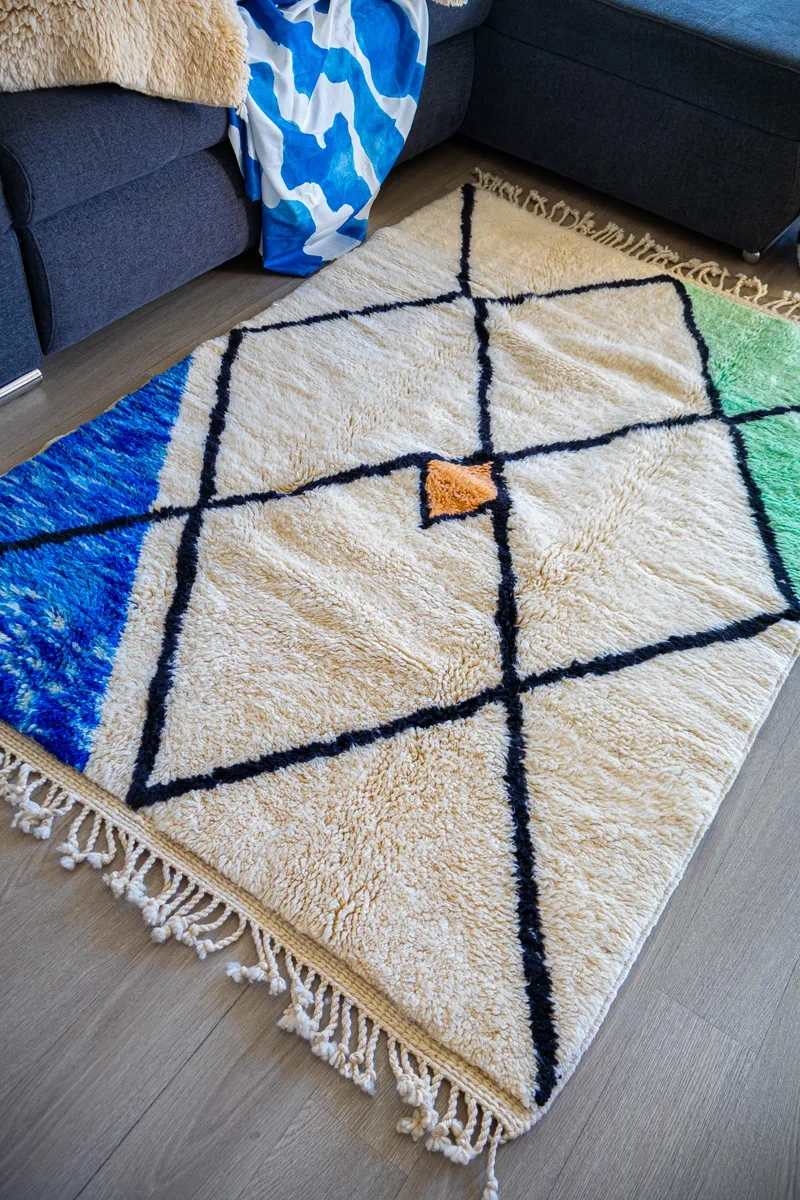
Our weavers are rooted in these traditions while bringing their own creative voice to every piece. The Mrirt Teal & Green Rug – Blue Green is a vivid example: bold colour, rhythmic composition, and the same 100% natural wool that runs through everything we offer.
How long does it take to knot a Berber rug?
The time required depends on the size, the knot density and the complexity of the pattern. A medium-sized rug can take several weeks of daily work. That investment of time — every knot set by hand, every colour decision made in the moment — is what separates an authentic hand-knotted rug from a machine-made imitation.
At TAKNAJ, every piece is selected for the quality of its knotting, the evenness of its weave and the integrity of its wool. Delivery is free across metropolitan France (2–4 business days). For full details on shipping across Europe, see our guide on Shipping Berber rugs to France and Europe.
- hand-knotted Berber rug
- natural wool
- Middle Atlas
- weaving tradition
- unique piece
Frequently asked questions
What is the difference between a hand-knotted Berber rug and a machine-made one?
A hand-knotted rug is built knot by knot by a single weaver, giving it a subtly irregular texture and a unique pattern that no machine can replicate. Machine-made rugs are identical copies produced at industrial speed, with none of the character or longevity of a handmade piece.
How can I tell if a Berber rug is genuinely hand-knotted?
Turn the rug over: the knots should be clearly visible on the back, slightly uneven in a way that reveals the human hand behind them. Natural wool also has a warmth and elasticity that synthetic fibres cannot match.
Which knot is used in Middle Atlas Berber rugs?
The asymmetric knot — also called the Persian or Senneh knot — is most common. The weaver loops a strand of wool around two warp threads and pulls both ends forward to form the pile, allowing for fine detail and consistent pile height.